Proof review
For: Prospects who need to understand current evidence before deeper work.
Outcome: Proof packet, claim boundaries, and fit/no-fit recommendation.
Investor diligence
The homepage is customer-first. This page routes investors into the diligence path: proof-bound claims, paid evaluations, IP protection, licensing potential, and ASIC feasibility review.
Positioning
ATOMiK is a state-aware compute architecture that helps edge and embedded teams reduce wasted state movement by tracking meaningful change instead of repeatedly moving, scanning, syncing, replaying, or rebuilding full state.
Diligence focus
Investor diligence should use the same claim discipline as customer evaluation. Do not turn evaluation targets into proven universal outcomes.
Buyer journey
For: Prospects who need to understand current evidence before deeper work.
Outcome: Proof packet, claim boundaries, and fit/no-fit recommendation.
For: Teams with one workload, one baseline, and one painful constraint.
Outcome: Workload map, metric plan, and evaluation readout.
For: Qualified teams where an early ATOMiK path could affect product or architecture decisions.
Outcome: Scoped collaboration around measured value and integration risk.
For: Chip, embedded, infrastructure, and strategic partners evaluating ATOMiK as IP.
Outcome: Proof-bound IP, hardware, ASIC feasibility, and licensing review.
For: Investors reviewing the transition from proof to evaluated customer/IP opportunities.
Outcome: Evidence map, paid-evaluation strategy, IP status, and ASIC feasibility path.
Proof packet
Benefits such as reduced heat, lower water burden, longer battery life, lower power, smaller footprint, or faster execution are evaluation targets unless a linked artifact measures that exact outcome.
Artifact map
The public site links to the evidence and benchmark page, hardware proof map, claims registry, and evidence labels.
Evidence labels
Claims are separated as live measured, hardware validated, software validated, formal proof, synthesis validated, build artifact, projected, conceptual, or roadmap.
Claim control
The registry records public-safe claims, artifacts, caveats, and overclaim risks for current public materials.
Hardware validated
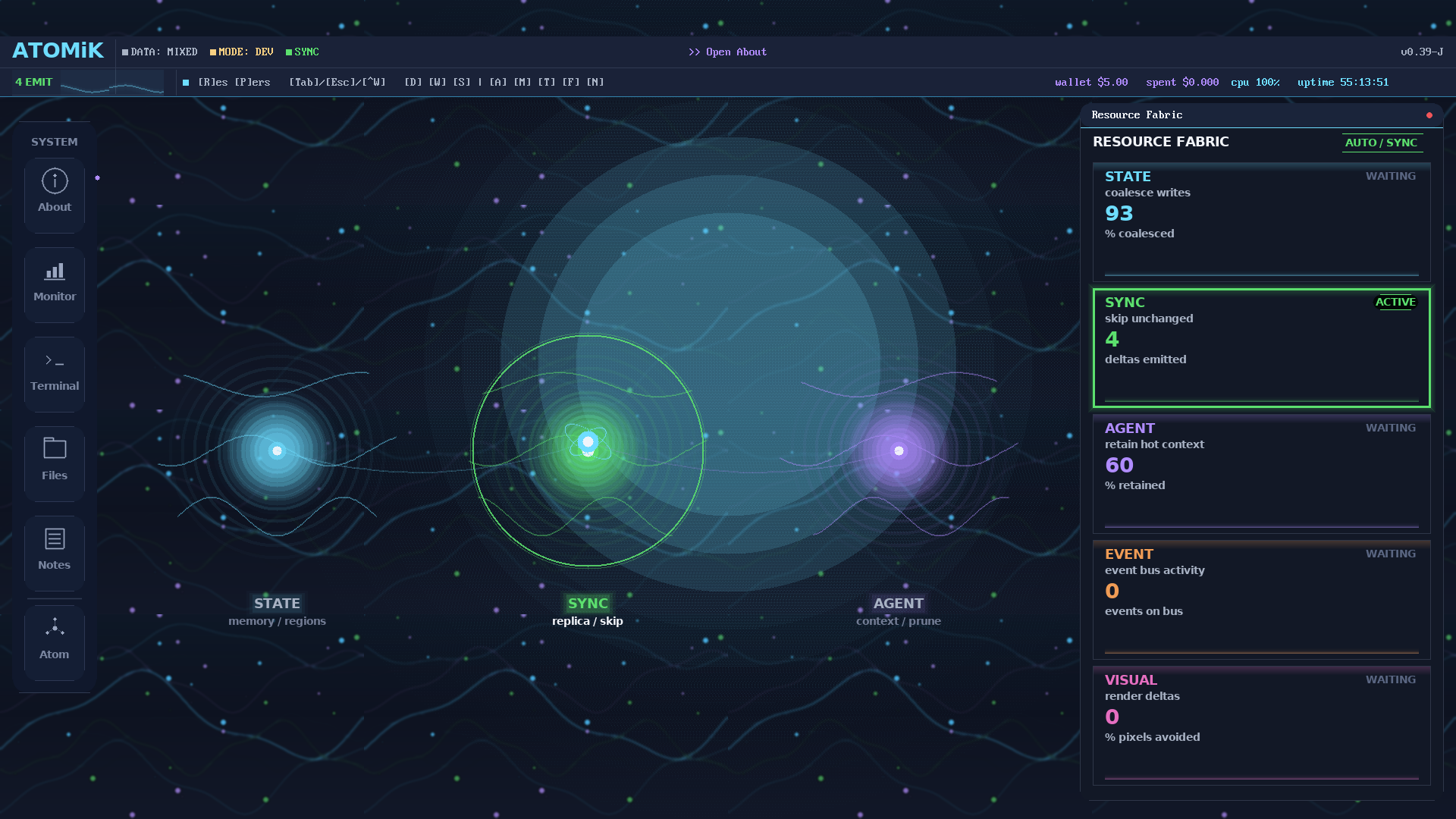
ATOMiK Desk v0.39-K is a current prototype UI screenshot running on live Zynq hardware. It is not proof of power, thermal, uptime, or production maturity.
Hardware validated
The Linux userspace proof validates the path from user process through Linux, MMIO, Wishbone CSR bus, and FPGA accelerator for algebraic checks.
Live measured
The matrix shows ATOMiK can win in specific coalesced/batched scenarios and lose in others. Use it with the interpretation caveats.
Formal proof
Formal proof work is present in the repository. Public pages should avoid unaudited proof counts unless the count is verified across repo, site, and deck.
Synthesis validated
Synthesis and toolchain outputs are useful evidence but must not be blended with live-board measurements.
Roadmap / conceptual
Concept visuals explain product direction only. They are not proof of current commercial functionality.
What capital de-risks
Paid design-partner evaluations against real workload constraints.
Stronger IP protection and diligence materials.
ASIC feasibility review before any production tape-out decision.
Proof packaging that keeps claims tied to artifacts.
Do not over-read
The AX7020 matrix shows workload-dependent behavior. Formal proof work exists but public pages avoid unaudited proof counts. Concept and roadmap visuals show direction, not commercial readiness.
The right review starts with the proof packet, claims registry, customer evaluation motion, IP status, and ASIC feasibility path.
Investor Diligence